Stainless Steel Mixing Bowls Set
Stainless steel mixing bowl set in multiple sizes for mixing, marinating, whisking, storing, and serving ingredients.
🛒 View on Amazon
Recipe
Bengali sweet-shop style motor alur tarkari with skin-on potatoes, whole yellow peas, mustard oil and a lightly starchy jhol.
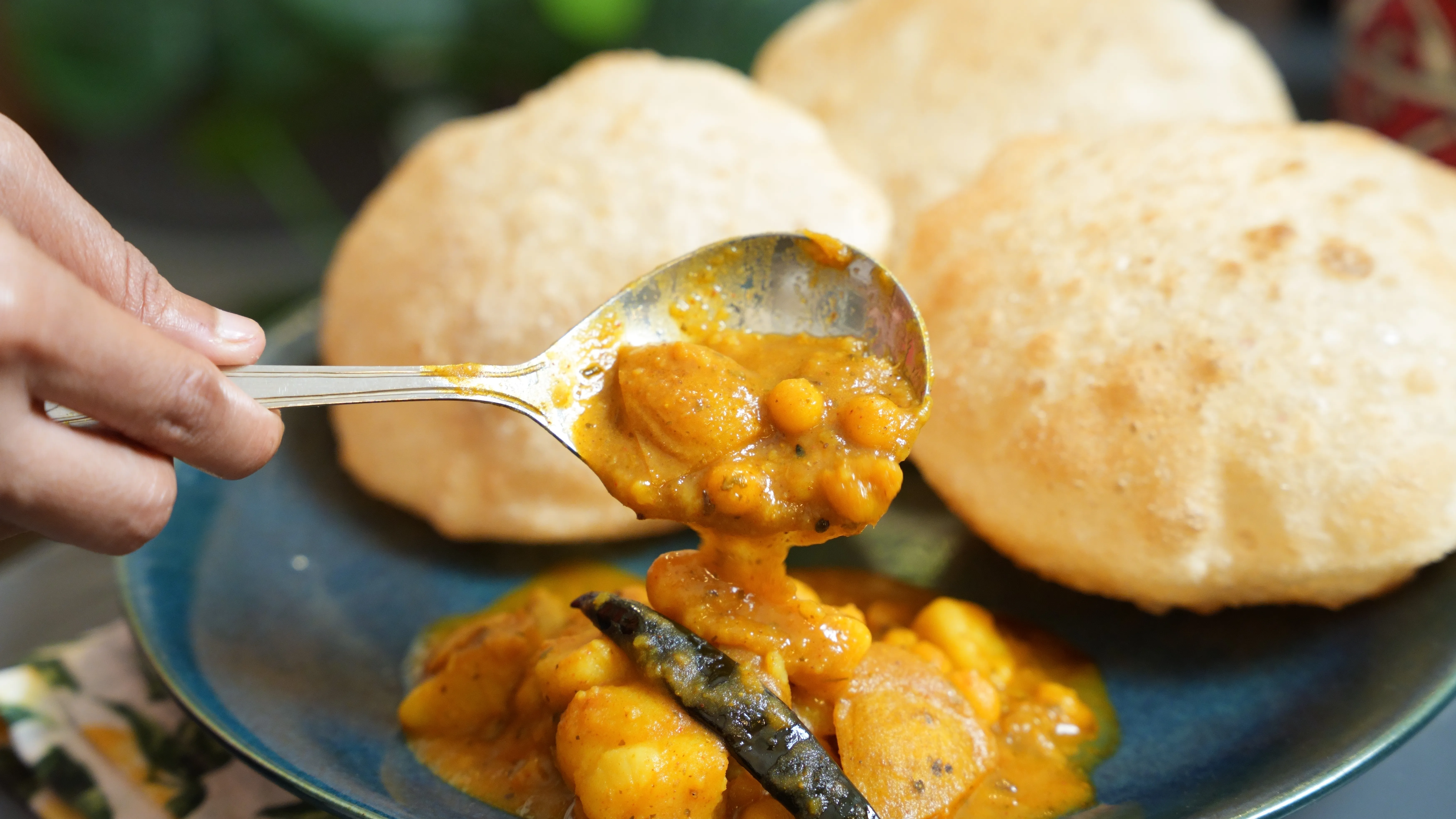
This Bengali sweet-shop style Motor Alur Tarkari is the familiar potato-and-peas curry served alongside kochuri. The character comes from the complete combination rather than one secret ingredient: skin-on raw potatoes go directly into mustard-oil tempering, followed by ginger and green chilli, whole yellow peas and hot water. As the potatoes cook, their starch naturally gives the jhol body. Black salt, kasuri methi, amchur and a tiny amount of Bengali garam masala are added at the end to complete the salty, spicy, faintly sweet, tangy and aromatic finish.
Stainless steel mixing bowl set in multiple sizes for mixing, marinating, whisking, storing, and serving ingredients.
🛒 View on Amazon
Premium Swiss chef knife with an exceptionally sharp blade, designed for precise slicing, chopping, and everyday food preparation.
🛒 View on Amazon
Heavy-gauge round-bottom iron kadai that distributes heat evenly, retains heat exceptionally well, and is perfect for frying, sautéing, and slow cooking.
🛒 View on Amazon
Stainless steel cooking spoon set with different spoon shapes for stirring, sautéing, serving, and everyday cooking tasks.
🛒 View on AmazonSoak the whole yellow peas overnight
Boil until tender but still holding their shape
Drain and keep aside; do not make mushy
Scrub the potatoes thoroughly but keep the skin on
Cut into approximately 3 cm chunks
Do not pre-boil
Crush the ginger and green chillies together
Keep the mixture slightly coarse
Heat mustard oil
Add dry red chillies, hing and panch phoron
Give the hing only a few seconds; let the panch phoron become aromatic without burning
Add the raw skin-on potatoes directly to the tempering
Add regular salt and mix well
Sauté so the potatoes get coated in the tempered oil and spices
Do not pre-boil the potatoes
Add the crushed ginger–green chilli mixture after the potatoes go in
Mix through and cook briefly so the raw aroma mellows without heavily browning the ginger
Add turmeric, Kashmiri chilli, coriander, cumin and sugar
Mix and cook briefly on low to medium heat
Do not turn this into a heavily bhuna/kosha-style masala
Add the boiled whole yellow peas before adding water
Mix through the potatoes and masala
Keep the motor intact rather than mushy
Add approximately 350 ml hot water initially
Cover and simmer for 10–15 minutes until the potatoes are completely tender
Add more hot water if needed, up to approximately 450 ml total
Allow the potato starch to naturally give the jhol body
If needed, gently break or mash only 1–2 potato pieces
Target a loose, lightly starchy jhol—not watery and not thick like aloo dum
Once the potatoes are cooked and the gravy has reached the correct consistency, add beet noon/black salt, crushed kasuri methi, amchur powder and a tiny amount of Bengali garam masala
Mix, check the final seasoning and switch off
Final taste should be salty, spicy, faintly sweet, faintly tangy, with hing/panch-phoron aroma and kasuri methi in the background
Whole yellow peas / motor সারারাত soak করুন
নরম হওয়া পর্যন্ত boil করুন, তবে shape যেন ধরে রাখে
জল ঝরিয়ে রাখুন; একেবারে mushy করবেন না
আলু ভালো করে scrub করে skin রেখে দিন
প্রায় ৩ সেমি টুকরো করুন
Pre-boil করবেন না
আদা ও কাঁচালঙ্কা একসঙ্গে crush করুন
মিশ্রণটি একটু coarse রাখুন
Kadai-তে সরষের তেল গরম করুন
শুকনো লঙ্কা, হিং ও পাঁচফোড়ন দিন
হিং কয়েক সেকেন্ডের বেশি নয়; পাঁচফোড়ন aromatic হওয়া পর্যন্ত দিন, পুড়তে দেবেন না
ফোড়নের পরেই raw skin-on potato দিন
সাধারণ নুন দিয়ে ভালো করে mix করুন
Tempered oil ও মশলার সঙ্গে আলু ভালোভাবে coat হওয়া পর্যন্ত sauté করুন
আলু pre-boil করবেন না
আলু দেওয়ার পর crushed ginger–green chilli দিন
ভালো করে mix করে অল্পক্ষণ রান্না করুন যাতে raw aroma কমে, কিন্তু আদা বেশি brown না হয়
হলুদ, কাশ্মীরি লঙ্কা, ধনে, জিরে ও চিনি দিন
Low to medium heat-এ অল্পক্ষণ mix ও cook করুন
Masala-কে heavy bhuna বা kosha করবেন না
জল দেওয়ার আগে boiled whole yellow peas / motor দিন
আলু ও মশলার সঙ্গে ভালো করে mix করুন
Motor-এর shape যেন থাকে, mushy না হয়
প্রথমে প্রায় ৩৫০ মিলি গরম জল দিন
ঢেকে ১০–১৫ মিনিট simmer করুন, যতক্ষণ না আলু পুরো নরম হয়
প্রয়োজন হলে আরও গরম জল দিন, মোট প্রায় ৪৫০ মিলি পর্যন্ত
আলু রান্না হওয়ার সময় তার starch-ই jhol-কে naturally body দেবে
প্রয়োজন হলে শুধু ১–২ টুকরো আলু আলতো করে break বা mash করুন
Target হবে loose, lightly starchy jhol—watery নয়, আবার aloo dum-এর মতো thick নয়
আলু সেদ্ধ ও gravy-এর consistency ঠিক হলে beet noon বা black salt, crushed kasuri methi, amchur powder ও অল্প Bengali garam masala দিন
ভালো করে mix করে final seasoning check করুন
চুলা বন্ধ করুন
Final taste হবে salty, spicy, হালকা sweet, হালকা tangy; সঙ্গে hing ও panch-phoron-এর aroma এবং background-এ kasuri methi
Keeping the skin on is a characteristic of this style of motor alur tarkari.
The raw potatoes cook directly in the tempered oil and later release starch into the jhol, helping build its body.
The motor needs to become tender while still holding its shape, so it can be added without becoming mushy.
As the raw potatoes cook in the gravy, they release starch into the liquid, naturally giving the jhol body.
Only minimally if needed. Breaking or mashing 1–2 pieces can help the gravy, but too much will make it thick like a potato gravy.
At the end, after the potatoes are cooked and the gravy has reached the right consistency.
Only a tiny amount—⅛ tsp. It should support the finish rather than make the curry taste like aloo dum.
Some reports describe this as a variation in certain sweet shops, but it should not be treated as universal. Regular sugar is sufficient.
Loose and lightly starchy, with enough body to coat the potato lightly but not thick like aloo dum.
Salty, spicy, faintly sweet and faintly tangy, with hing and panch-phoron aroma and kasuri methi in the background.
 Watch on YouTube